Tag: Mergers and Acquisitions

  • Microsoft’s Activision acquisition: rocket fuel for Microsoft’s gaming ambitions

    Microsoft’s Activision acquisition: rocket fuel for Microsoft’s gaming ambitions

    Takeaways from the Microsoft-Activision deal

    With emerging technology playing a crucial part in today’s gaming experience, it makes sense for Microsoft, a leading technology and gaming company, to acquire Activision, a leading game publisher. Microsoft is set to benefit from the deal to a great extent by leveraging an ecosystem composed of its products and services which complement one another. However, Activision brings many positives and negatives, and it is up to Microsoft to strategically address them. The path ahead is difficult but, if properly implemented, would prove invaluable for Microsoft’s global gaming domination.

    Gaming is a multi-billion dollar industry today

    From pixelated characters on screen to stunning visual graphics and player experience, the gaming industry surely has come a long way. It is a multi-billion-dollar industry currently and is expected to cross $200 Bn in 2023.

    Current scenario of the gaming industry

    Gaming has been an integral part of society, and as the world goes increasingly digital, the prospects of the gaming industry look even more enticing. The total gaming market is expected to balloon further as mobile penetration increases amongst the masses.

    Some key gaming trends

    Rise of mobile gaming

    Mobile gaming has seen a tremendous rise since the advent of application stores like Google Play and Apple’s iOS store. Mobile gaming revenue reached $76.7 Bn at the end of 2020 and is expected to increase steadily. The pandemic’s negative impact on the mobile gaming section has also been largely limited since the hardware is not a limiting factor, unlike gaming PCs and consoles.

    Popularity of e-Sports

    Gaming is now a lucrative career option, and tournaments are watched by millions of eager spectators and sponsored by game publishing and developer companies. Esports is gaining both popularity and acceptance amongst the masses and is aided by a digital mediums like YouTube and Twitch where streamers play their favorite games and earn donations from fans.

    Asia Pacific to be an important gaming region

    The Asia Pacific is emerging as one of the most important geographies for gaming, accounting for almost half of worldwide gamers. The primary drivers for this leadership can be attributed to increasingly better internet infrastructure, an increase in online population, and affordable internet. Countries like Japan, China, and South Korea are the torchbearers of the Asian gaming industry.

    Role of emerging technologies in gaming

    Emerging technology is one of the key aspects of the gaming industry currently, as it is directly related to the overall gaming experience. Top gaming companies like Microsoft, Tencent, and Sony understand this well, and to a large part, their expertise in technology has enabled them to become leading gaming companies today.

    For Microsoft, it can leverage its years of hardware experience in the form of its running Xbox consoles, its acquisition of several important gaming studios and developers, and its leadership in cloud and artificial intelligence to further strengthen its position as a go-to choice for gaming, especially when the role of emerging technologies is becoming ever so important.

    What does the acquisition bring to Microsoft Xbox?

    Although Xbox will have many potential advantages with the acquisition of Activision Blizzard, there are some areas of concern as well. The following pointers will strive to throw some light on them-

    Benefits of the acquisition

    I. Activision’s share in e-Sports

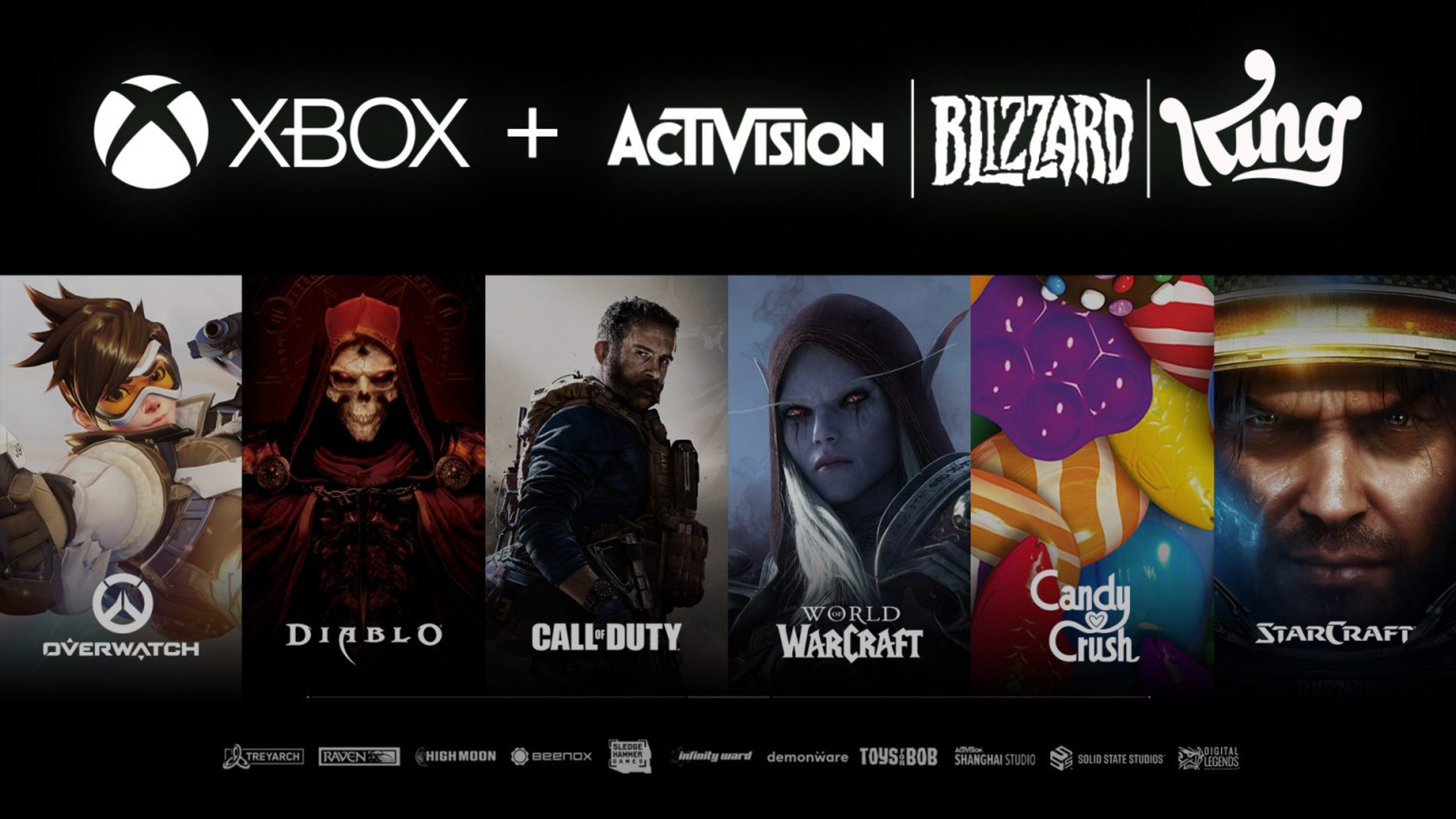
    Activision has a good presence in the e-Sports industry as its subsidiary Blizzard entertainment owns massive IPs like Overwatch, StarCraft II, and Hearthstone, which are some of the best-known first-person shooters (FPS), strategy, and turn-based games respectively.

    ii. Mobile gaming potential

    Xbox can leverage the Candy Crush series developed by King, which Activision Blizzard acquired in 2016 to fulfill its mobile gaming aspirations. There is a huge market for cross-platform gaming, and mobile gaming is a key component of the PC-Console and Mobile trinity. Two of its highly rated games, Candy Crush Saga and Candy Crush Soda Saga each have more than a billion downloads on the Google Play store.

    iii. Player base

    Xbox can now use Activision’s existing player base of 400 million active players spread across 190 countries, in addition to 30 game development studios. This will also help Xbox add subscribers to its cloud-based gaming subscription service, Game Pass, which is already 25 Mn subscribers strong. The acquisition will also add around 10,000 of Activision’s experienced gaming employees to the Xbox umbrella.

    iv. Popular Activision IPs

    Activision owns popular games like Call of Duty, Candy Crush Saga, and World of Warcraft. Its most popular title, Call of Duty has been running since 2003 and has sold millions of copies to date. With the current subscription-type revenue model in gaming combined with Activision’s massively popular IPs, Xbox is well-positioned to benefit to a great extent.

    v. Technology additions

    Activision’s IW engine, created by Infinity Ward has been powering its Call of Duty franchise and is currently in its eighth version. Microsoft can make use of the IW engine for further developing large map-based first-person shooter games and combine it with XNA, a set of frameworks and tools which helps develop games.

    Detriments of the acquisition

    i. Declining sales

    The sale of Call of Duty has dropped in recent years, with the peak sales being attributed to Black Ops which was released in 2010. In the UK, in 2021, Call of Duty: Vanguard sold 36% fewer copies compared to its previous year’s game, Call of Duty: Black Ops Cold War. Xbox will have the hefty task of reigniting public interest in the series. Maybe we will see much more marketing and perhaps several e-Sports tournaments being organized around the game in the near future.

    ii. Losing brand value

    Activision’s brand value has been taking a hit as it has been embroiled in scandals, specifically in 2021 when-

    1. California’s Department of Fair Employment and Housing (DFEH) sued Activision Blizzard for violations related to equal pay, sex discrimination, and sexual harassment in July. Former female employees of the company shared negative experiences during their term at the company, and a massive walkout and protest were organized by the employees during the same time.
    2. Activision Blizzard in September agreed to settle a lawsuit by the U.S. Equal Employment Opportunity Commission (EEOC) which alleged discrimination and harassment in the workplace. Activision, as a result, will create an $18 Mn fund to compensate and fund claimants, and any remaining amount will be divided between charities
    iii. Revenue performance

    Although Activision seems to have performed well in recent years, its revenue growth dropped steeply from ~25% in 2020 to 8.9% in 2021 with periodic crests and throughs throughout, suggesting which is an area of concern. In its Q4FY21 earnings, its quarterly earnings fell by 10.3% as compared to last year driven by low sales in its Call of Duty franchise.

    iv. Lack of new games

    Activision has essentially not put a new game on the market since Overwatch, in 2016. Although, in late January this year, it announced via Twitter it is building a new survival game which would be the studio’s first survival game. Time will tell how this would compare with the best out there in this category, namely The Forest, DayZ, Subnautica, and of course, Minecraft.

    Microsoft’s strategy to become the gaming market leader

    Key acquisitions by Microsoft in the past

    It should be noted that Microsoft’s acquisition of Activision Blizzard is not the first gaming-related acquisition; it has been busy acquiring gaming studios for the past few decades. However, this acquisition, in monetary terms, is more than 8 times its next most expensive gaming acquisition, that of Zenimax Media.

    1. Although the Rare deal happened decades ago, it set into motion Microsoft’s subsequent game studio acquisitions. It is also one of the major deals for Microsoft right after it started Xbox. It is the market consolidation, in terms of adding exclusive present and future titles and active players that Xbox has aimed at with these acquisitions. Brand value plays an important role in this aspect as well as adding well-known titles will translate to better Xbox subscriptions and console sales.
    2. Another important aspect is the fact that Microsoft has allowed several of its acquired studios to function as independent bodies under the Xbox banner. This has allowed the studios creative freedom and enabled them to make their own decisions for their respective game titles. It remains to be seen whether Microsoft will function independently as well.

    The Metaverse angle

    Metaverse is now much more than just a buzzword, and the gaming industry is uniquely aligned with the metaverse concept. Interaction and digital worlds are at the very heart of the metaverse, and the gaming industry provides just that. Minecraft, developed by Mojang studios already has a huge digital world in place with in-game player interactions in the form of combat, base building, and exploration. Another important aspect is digital transactions, and because of micro-transactions already being a major revenue-driving force in the gaming industry, the synergy between gaming and metaverse is greatly increased. Microsoft has already put in place a metaverse technology stack that makes use of its present ecosystem of products and services, and the gaming component will act as an experience layer with which the user will interact.

    Source- https://azure.microsoft.com/en-gb/blog/converging-the-physical-and-digital-with-digital-twins-mixed-reality-and-metaverse-apps/

    What does the future look like for Microsoft?

    From Xbox to Microsoft Gaming

    Microsoft wants to position its Xbox ecosystem (including Xbox Game Studios, Game Pass subscriptions, and gaming consoles) to be an overarching destination for all things related to gaming. Since 2018, Microsoft has combined all its Xbox hardware and software services comprising Xbox Live subscriptions, advertising and transactions, video games, and third-party video game royalties into a condensed section called gaming. Microsoft also appointed Phil Spencer as the CEO of Microsoft Gaming in January 2022, after the acquisition. This strengthens the reason that Microsoft is viewing Xbox not solely as a game console division but as a one-stop destination for all things gaming.

    Source- https://news.xbox.com/en-us/2022/01/18/welcoming-activision-blizzard-to-microsoft-gaming/

    Xbox’s revenue has been continuously on the rise in the past couple of years, and with this acquisition, it is only expected to increase as loyal Activision fans will be added to Xbox’s player numbers who in turn will get involved with micro-transactions inside the game.

    Xbox has been battling Sony’s PlayStation for many years now in the console games market, and this acquisition is aimed at strengthening its position in the console and games market. The scale of Microsoft’s Activision acquisition can be appreciated much more when we consider that at $ 68.7 Bn, it is only $ 1.3 Bn short of the combined value of its next 5 biggest acquisitions. The addition of Activation games into the subscription services will help Microsoft further position its subscription service as a preferred alternative to Sony’s PlayStation Plus.

    With the acquisition, Xbox will most probably become the third biggest gaming company by revenue after Sony and Tencent. This trend of acquisitions is expected to continue for Microsoft as they will always be on the lookout to acquire popular gaming titles for their Xbox portfolio.

    Conclusion

    To conclude, Microsoft, with this acquisition will not only strengthen its gaming portfolio but will also be able to fortify its place in the metaverse race with the help of its already flourishing ecosystem of products and services. Microsoft is well on the path to making use of this ecosystem in the increasing trend of cloud-based cross-platform gaming that is being observed across the industry. This acquisition is thus a key move made at a strategic time when the importance of emerging technologies and an ever amalgamation of the physical and digital world is becoming increasingly prevalent.

    For Activision, aligning with a technology giant will allow it to have the crucial assets it needs to become future-ready. Additionally, its brand will definitely get a much-needed boost. For Microsoft, it gained strong steps toward realizing its aspirations of becoming a gaming market leader by adding Activision’s huge player base, popular I.P.s, and employees. What matters next is how the integration will be done as it is key for Microsoft to reap the intended benefits which in turn will dictate the return on investment.
  • “Are you sure it isn’t photoshopped?” – The journey of Adobe

    “Are you sure it isn’t photoshopped?” – The journey of Adobe

    Adobe is one of those rare companies whose product (Photoshop) has become a verb. This Digital Dribble article aims to take a deep dive into Adobe’s history and understand what makes the company the behemoth that it is today. The reason we’re discussing Adobe is because of several factors- the primary being its improvement in ranks over the years and the fact that we wanted to choose a company that is not ranked in the top 200. This is because of the human tendency to only focus on the best of the best and ignore the underdogs.  Adobe has continuously impressed everyone with its growth and tenacity, and this article aims to analyze everything from the company’s strengths and weaknesses to the reasons for its success. 

    Currently, Adobe has an excess of 25,988 employees, its Net Income is US$ 4.82 billion, and its Revenue is US$ 15.785 billion with operating costs of US$ 9.983 billion.

    Source: Forbes Website

    History

    Adobe, like many other billion-dollar companies, had a humble beginning. It was founded in the garage of John Warnock, one of the founders. The company is named after Adobe Creek, which is a 23-kilometer-long stream originating in Santa Clara County, California, that flows behind Warnock’s home.

    Growth Drivers (in India and the World)

    One of the key drivers of growth for Adobe is the overall growth of digital marketing in India and around the world. Digital marketing is set to grow with improving disposable incomes and internet penetration in India as well as around the world. The need for digital tools is rapidly increasing and Adobe excels at making them. This will ensure that Adobe products are used continually, essentially making them perennial.

    Source
    Source

    Product Division

    Adobe has a wide variety of product lines that have enabled it to become the market leader it is today. Adobe’s website prudently allows classification by dividing its entire product category into four broad labels:

    A. Creativity and Design

    B. Marketing and Analytics

    C. PDF and E-Signatures

    D. Business Solutions

     These four are further sub-divided into several different segments, and the complete product segmentation is given below:

    A. Creativity and Design

    1. Design (Notable Products: Photoshop, Illustrator, InDesign, Aero, Adobe XD, Behance, Dimension, Dreamweaver, Dimension)
    2. Photography (Notable Products: Lightroom, Photoshop Elements, Lightroom Classic, Creative Cloud for Desktop and Mobile, Stock)
    3. Video and Audio (Notable Products: Premier Pro, Premier Rush, After Effects, Anywhere, Photoshop Camera)
    4. Web and UX (Notable Products: Animate, Comp, InCopy, Adobe Spark, Spark Page, Spark Post)

    B. Marketing and Analytics

    1. Advertising (Notable Products: Advertising Cloud, Experience Cloud, Media Optimizer and Dynamic Creative Optimization)
    2. Analytics (Notable Products: Analytics, Analytics Cloud, Audience Manager, Experience Cloud)
    3. Marketing (Notable Products: Campaign, Experience Manager, Primetime, Target)

    C. PDF and e-Signatures

    1. Documents (Notable Product: Document Cloud)
    2. E-Signatures (Notable Products: Acrobat Pro DC, Adobe Sign, Adobe Sign Mobile App, Fill and Sign)
    3. PDF (Notable Products: Adobe Scan, Acrobat Pro 2020)

    D. Business Solutions

    1. ColdFusion (Notable Products: ColdFusion on AWS, ColdFusion Standard (2018))
    2. E-Learning (Notable Product: Captivate)
    3. Enterprise (Notable Products: Creative Cloud for Enterprise, Document Cloud for Enterprise)
    4. Print Imaging (Notable Products: Design to Print, Adobe Embedded Print Engine, Adobe PDF Print Engine, Adobe PostScript)
    5. Technical Communication (Notable Products: Technical Communication (2019), XML Documentation for Adobe Experience Manager)
    Source

    Therefore, it is evident that Adobe has a huge stockpile of products that it uses to maintain its market dominance over its competitors. The four major areas that are mentioned above cover hundreds and thousands of businesses and individuals, and Adobe has successfully used that factor to market its products and successfully reap benefits from it.

    Mergers and Acquisitions

    Mergers and acquisitions are important for an organization from a growth perspective. They change the way the business operates strategically now as well as in the future. Adobe has, over the years, acquired all kinds of companies including those that were themselves considered giants. Some of Adobe’s notable acquisitions are listed below:

    Name of CompanyAcquired onAcquired for (in US $)
    MarketoSeptember 20184.75 billion
    MacromediaDecember 20153.573 billion
    OmnitureSeptember 20091.8 billion
    MagnetoMay 20181.68 billion
    FotoliaJanuary 2015.8 billion
    NeolaneJuly 2013.6 billion
    Frame TechnologyOctober 1995.57 billion
    • The quintessential and ubiquitous Adobe PDF that we see and use all around us has been made possible by several key acquisitions by Adobe over the years-
      • OCR Systems (1992)- The technology of this company made it possible to manipulate the documents that were scanned into PDFs.
      • Aldus Corp (1994)- This merger helped bring PDFs to desktops.
      • Accelio Corp. (2002)- This company’s server-based technology is implemented in Adobe LifeCycle Design.
      • Macromedia Inc. (2005)- Many of Adobe’s PDF features like mobile PDFs, media-rich PDFs, or online collaboration would not have been possible without this company
    • Adobe added Behance to its creative cloud community strengthening further its hold over the industry
    • By integrating Adobe Sign (EchoSign) into its ecosystem of products, Adobe ensured that one of the pain points- the inability to electronically sign PDFs was addressed.

    Marketing Strategy

    Adobe uses a strong content marketing strategy to bolster its position in the industry. The result has been nothing short of spectacular for Adobe. In 2018, it crossed several key landmarks, the most impressive of them being exceeding a market capitalization of $ 100 Bn. With its ‘always-on’ marketing, Adobe constantly reviews and analyses marketing data rather than spending crucial time building the perfect marketing plan. This allows the company to change whatever is needed while on the go, thereby making it much more agile. This policy has enabled the company to craft strategic marketing campaigns, fine-tune these strategies, and adopt effective practices.

    Factors That Made Adobe Successful

    It becomes important to understand the reasons behind the success of Adobe as a company, and that can be best done by using a couple of tools that help in analyzing the company as a whole.

    Competitor Analysis of Adobe

    This section analyses the position of Adobe and where it stands along with its competitors. The problem with a company like Adobe (which is also its strength and competitive advantage) is the fact that no other competitor offers a diverse bouquet of products that are so uniquely related in a common ecosystem as Adobe. Hence, to do a competitor analysis, different companies that belong to different sectors and segments need to be brought together.

    SWOT Analysis of Adobe

    Strengths

    • One of Adobe’s key strengths was its ability to transition from a perpetual licensing system to a subscription-based licensing system. This led to an increase in their ARR (Annualized Recurring Revenue) which will help provide the company with reliable cash flows in the future.
    • Adobe products are used and preferred all over the world, thereby adding to its brand equity. Its strong global presence can be rivaled only by a few of its competitors. Few of Adobe’s competitors have been able to consolidate a vast array of products under its portfolio as effectively as Adobe has.
    • Adobe distributes its offerings through a network of value-added resellers (VARs), original equipment manufacturers. (OEMs), a detailed network of distributors and independent software vendors (ISVs)
    • Adobe has an almost pure monopoly when it comes to designing, as Photoshop overshadows its competitors by miles. Similarly, Adobe caters to the film, web development, and the video game industry, to name a few.
    • The Adobe brand has been growing over the years and is now perceived to be a trusted one amongst designers and other users. It has steadily captured the market share by defeating all of its rivals.

    Weaknesses

    • The primary weakness of Adobe is its high price which deters many potential customers Adobe products are sold more in developed markets and less in emerging ones.
    • Poor customer service is also one of the key weaknesses of Adobe.
    • Adobe’s poor presence in the video animation industry, especially in 3D modeling is also a potential weakness as it is an empty void that competitors can now fill.

    Opportunities

    • With the increase and growth in industries like digital marketing, PR, branding, and a host of other industries, Adobe still has plenty of room to grow and expand globally.
    • The increasing demand for cloud computing coupled with the subscription model can lead to increased profitability for the company. Adobe Creative Cloud desktop apps are a set of Adobe products that give the user control to a set of applications that have optional cloud services as well. Adobe needs to expand on this cue.
    • Adobe and Microsoft have entered into a strategic alliance wherein each company will help the other in transforming businesses globally by leveraging the latest developments. Adobe has chosen Microsoft’s cloud platform Azure as its preferred choice for its cloud offerings- Adobe Document, Creative, and Marketing clouds.
    Source

    Threats-

    • The major threat for Adobe is the threat of piracy due to the thriving torrent sites and peer-to-peer networks. This severely harms the company as it essentially is robbed of its revenue. This mostly happens in emerging markets like Russia, Africa, Pakistan, and India.
    • There are several substitutes for Adobe products that are either free or cost minimal to purchase. Some of the best Photoshop alternatives are- Luminar, GIMP, Pixlr, and Paint. 
    Source
    •  Security threats are another set of worries that Adobe has to carry around with it all the time. Adobe has a lot of information about its customers, which is confidential. Hackers often try to attack Adobe servers, and they also are continuously developing malware and viruses for this very purpose. This also harms the brand image that Adobe has so painstakingly created over the years.

    Reasons for Adobe’s Success in India

    Adobe has gained a lot of traction in India, and in addition to the growth drivers mentioned above at the start of the article, a few key pointers that need to be highlighted

    • Adobe earned a spot in the Top 10 Best Places to work in India in the year 2019 and came in at a respectable 7th.
    • In 2018, Shantanu Narayen, the CEO of Adobe India, won the Global Indian of the Year. Shantanu has been with Adobe for a long time and has helped it in its key projects like the transition to a cloud-based subscription model rather than one-time licensing software.
    • Adobe first came into the country in the year 1997 and as of 2017 has more than 5,200 employees across four campuses in the cities in the cities of Bengaluru and Noida.
    • The India business for Adobe is one of its fastest-growing in the Asia Pacific regions
    • The strong growth is spearheaded by growing industries such as education, e-learning, fintech, insurance and retail.

    Evergreen market

    The picture below proves that Adobe’s very business model and the products it has been dealing with have suffered little to no consequences because of the global pandemic. Being largely digital products, they can be facilitated over the internet and the need for digital marketing and associated activities is always on the rise thereby contributing to the company’s revenues even during a global pandemic.

    Want to read about how COVID-19 affected business strategies for other companies? Check out this Digital Dribble article.

    Source