I remember it was still the wee hours when I heard my father speaking over the phone in the adjoining room of our apartment, careful as always not to wake me up. My mother was in the hospital and was scheduled to have a critical hernia operation that day; hence, my first thought was it was a call from the hospital authorities. As I approached him, trying my best to rub the sleepiness away, I heard the dreaded words, “Didu is not responding.”
It felt like someone had snatched the ground underneath my feet. My grandmother, a cancer survivor, stayed not far away from us, and she had a caretaker, Jharna, whom I adoringly called Jharna Pishi. She was the one who called. My father and I quickly became ready and boarded a rickshaw, fearing the worst. “Man proposes, god disposes,” I thought; there could not be a worse day for this to happen.
*——*—–*—–*—–*—–*
As the rickshaw picked up pace, I fixed my gaze on the asphalt road, and almost as if hypnotically, my mind started going back to the past. When I was studying in class 11th, my grandmother was diagnosed with breast cancer. Typical of her nature, she did not let us know until it was much too late, and her symptoms had already rolled onto stage three. My mother then took up the mantle of saving her, handling everything single-handedly, from doctor’s appointments, radiation, chemotherapies, and other diagnostic tests, to the procurement of medicines.
The relentless day-long radiation and chemotherapies did not come without their price; my mother had to sacrifice entire days’ worth of meals to get them done on time. This led to her developing her own set of gastrointestinal issues over the years. As my grandfather was with the central government, we were lucky to avail the central government health schemes for treatments and doctor consultations. But as with everything related to the government, there was a never-ending trail of bureaucracy. Standing in serpentine lines to fill a sheet of paper, only to hear from across the counter that a photocopy of an insignificant document was missing, was part of my mother’s daily life.
Through sheer will on both my mother’s and my grandmother’s part, she was able to defeat the cancer. My grandmother often spoke highly of her daughter, with a proud shimmer in her eye, saying my mother is the reason she is alive, albeit, at the cost of her daughter’s life. She even lamented the harsh treatments she meted out to my mother when she was young.
My father also helped a lot whenever he could after balancing his hectic job; he would always take care of the application writing to doctors, diagnosticians, and government medicine distributors, something which is part and parcel of the bureaucratic process in our country.
*——*—–*—–*—–*—–*
Death gives you perspective, to the extent that everyday living does not, cannot. This is made all the more apparent when someone very close to you departs; as you now know, nothing can make them come back. When I first saw Didu’s lifeless body, my thoughts froze, yet my legs kept walking, circling her bed, trying to comprehend what had happened. My father, who has a very strong head on his shoulders, told me to check her pulse using the oximeter we gave our grandmother for periodic pulse checking. I immediately sprang to action, and as soon as I touched my grandmother’s fingers to put the machine into, I felt the coldness of her skin travel up my spine, almost like a shock. If I was unwilling to accept reality before, this ensured I came to terms with it.
What followed soon after was nothing short of a whirlwind, from informing relatives to ensuring that my mother did not immediately know of my grandmother’s demise, as that would definitely make her condition worse. Before my mother was to know about her mother’s death, someone for whom she gave up most of her life force running between counters and doctors’ receptionists for appointments, it was vital to ensure she was stabilized and strong enough to withstand the devastating impact it would create in her mind. After finally breaking the news to her, we had to complete all the hospital discharge formalities, as there was no way that her operation would take place amidst this tragedy.
I remember following the hearse that night to the funeral home, catching glimpses of her feet between the incessant cars during traffic jams. The same feet I had touched when I went for my graduation and later when I left Kolkata for my job in Hyderabad. As I lowered her lifeless body onto the metallic platform connected with the electric crematorium, my hands and knees became shaky at the very last moment, and her head banged on the metallic floor with a soft thud. I almost blurted out, “Aha!” a sympathetic tone that we Bengalis often use to pacify someone who is hurt. Again, death gives you perspective to the extent that everyday living does not, cannot.
*——*—–*—–*—–*—–*
As I walked past the familiar gourmet ice cream shop, I quickly tried to divert my attention, focusing intensely on the video I was already listening to, even increasing the volume of my Bluetooth headphones to full blast. But the flood of thoughts came rushing in, nevertheless.
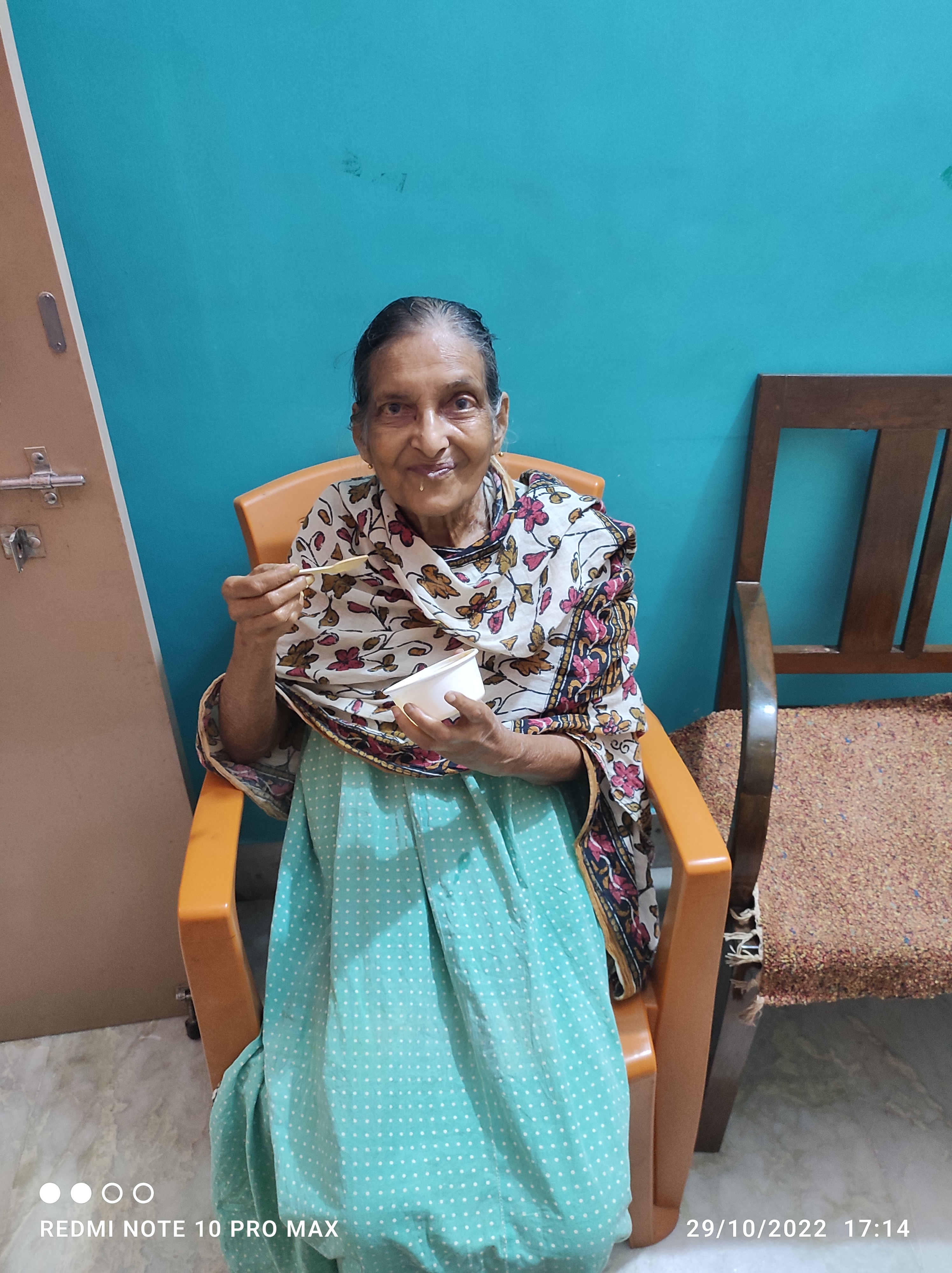
“Maa, this ice cream shop has just opened, and it looks like they have some excellent stuff in here! I am buying a scoop or two for Didu.” I remembered having this conversation with my mother. It has been several months since the “incident,” but sometimes places and things have a unique way of dragging you right into the past, much like a time machine, only inside your head. Didu loved the mango-flavoured ice cream that I had bought for her that day; it was Alphonso-flavored. “Babu,” she said endearingly, smiling through her gums, “This must have cost a lot of money!” I loved spoiling her with anything and everything, only to see her reaction, which was a combination of happiness and apprehension, mostly worrying about the cost of the items I pampered her with.
*——*—–*—–*—–*—–*
Didu used to constantly worry about us, excessively, to the extent that she would almost go insane even if me or my parents caught a minor cold. Therefore, I think, she could not bear the tension of my mother going under the knife again. My mother had multiple operations previously, relating to her cesarean section and an almost gangrenous gallbladder removal. It seemed like the thought of her daughter going for an operation again weighed too much on her chest.
In the end, what was remarkable was her face seemed serene, almost as if she had a smile on her face. Her passing away did not alert Jharna Pisi, who always remained extra vigilant. We want to think that she passed away peacefully, again, typical of her nature, without disturbing anyone. Even though the wounds are too big to heal right now, I think it would be best if I tried to live by the quote, “Time heals all wounds; give time, time.”
P.S.- The picture is from when I bought the ice-cream scoops for her, just a few months before she passed away.
~written by Biswadeep Ghosh Hazra