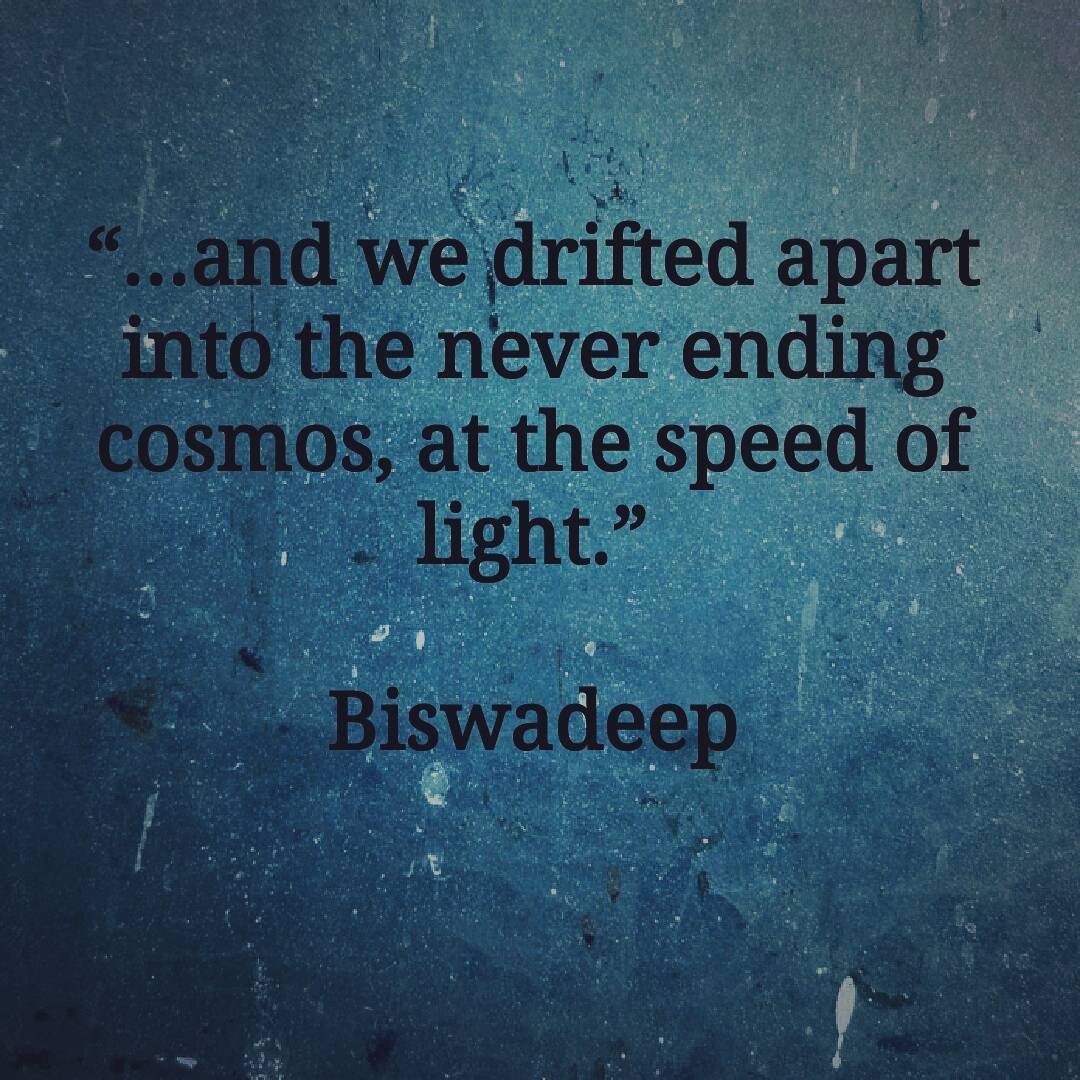
Tag: space

  • #insta_creations (Part-XVII)

    #insta_creations (Part-XVII)

    1)May I be the salt in your tears, so that you can taste it innocently?

    2) Life and death were dedicated lovers, but no love is complete without a heart-wrenching quarrel. Every time they quarreled, somebody died an agonizing death. Every time they reconciled, someone drew their first breath.

    3) I’ll be your skin if you’ll be my goosebumps.

    4) He had heterochromia iridium; one of his iris was blue and the other, black. Everybody labeled him as a freak, some went to even greater lengths and said he had the eyes of a demon.

    But to her, he was perfect, as perfect as perfection itself. She saw her sky and darkness reflect through his eyes.

    “What do you love about me,” he asked playfully.
    “Your eyes,” she replied and returned back the smile.
    “Why?”
    “Because they remind me how imperfect we can be in the eyes of many but just perfect in the eyes of one.”

    His soul had dual colors from that day onwards.

    5) “But how much is forever?”

    “Till the time you feel tired and decide to leave me behind and move on…”

    6) I’m a scavenger of sorts, picking up emotions on the road of life. I’ve filled my pockets with anger, hope, jealousy, love, greed, empathy, hatred, sympathy, lust and a lot, which is an amalgamation of two or more of any of the emotions mentioned here.

    I ran out of pockets, long back. I had to spill some to fill in the rest. More than a quarter of my journey later, I’ve realized that love wasn’t needed much. Not in this world, not in this lifetime. Maybe in some other…

    7) The hungry model satiated herself with hungry stares from the onlookers. Both craved meat, albeit in different forms.

    8) If I could imagine my whole life in a book, you’d be the bookmark. Every time I open the book to read or to write a new chapter, I’m reminded of you.

    9) I’ll wait for a world which will use words as viruses to infect the heart, the brain, and the soul. I’ll see you there.

    10)She looked beautiful in a snapchat filter, decorated with virtual flowers. Not very far away, a little girl who sold flowers for a living scolded her tummy for being hungry.

    © Biswadeep

    Image courtesy- Myself

  • Overcoming Writer’s Block with Automatic Transcription

    Overcoming Writer’s Block with Automatic Transcription

    Screenshot001

    If you’re a writer — of books, essays, scripts, blog posts, whatever — you’re familiar with the phenomenon: the blank screen, a looming deadline, and a sinking feeling in your gut that pairs poorly with the jug of coffee you drank earlier.

    If you know that rumble all too well: this post is for you. Maybe it’ll help you get out of a rut; at the very least, it’s good for a few minutes of procrastination.

    Here’s the core idea: thinking out loud is often less arduous than writing. And it’s now easier than ever to combine the two, thanks to recent advances in speech recognition technology.

    Of course, dictation is nothing new — and plenty of writers have taken advantage of it. Carl Sagan’s voluminous output was facilitated by his process of speaking into an audio recorder, to be transcribed later by an assistant (you can listen to some of his dictations in the Library of Congress!) And software like Dragon’s Naturally Speaking has offered automated transcription for people with the patience and budget to pursue it.

    But it’s only in the last couple of years that automated transcription has reached a sweet spot — of convenience, affordability, and accuracy—that makes it practical to use it more casually. And I’ve found it increasingly useful for generating a sort of proto-first draft: an alternative approach to the painful process of converting the nebulous wisps inside your head into something you can actually work with.

    I call this process idea extraction (though these ideas may be more accurately dubbed brain droppings).

    Part I: Extraction

    Here’s how my process works. Borrow what works for you and forget the rest — and let me know how it goes!

    • Pick a voice recorder. Start talking. Try it with a topic you’ve been chewing on for weeks — or when an idea flits your head. Don’t overthink it. Just start blabbing.
    • The goal is to tug on as many threads as you come across and to follow them as far as they go. These threads may lead to meandering tangents— and you may discover new ideas along the way.
    • A lot of those new ideas will probably be embarrassingly bad. That’s fine. You’re already talking about the next thing! And unlike with text, your bad ideas aren’t staring you in the face.
    • Consider leaving comments to yourself as you go — e.g. “Maybe that’d work for the intro”. These will come in handy later.
    • For me, these recordings run anywhere from 20–80 minutes. Sometimes they’re much shorter, in quick succession. Whatever works.

    Part II: Transcription

    Once I’ve finished recording, it’s time to harness ⚡️The Power of Technology⚡️

    A little background: over the last couple of years there’s been an explosion of tools related to automatic speech recognition (ASR) thanks to huge steps forward in the underlying technologies.

    Here’s how ASR works: you import your audio into the software, the software uses state-of-the-art machine learning to spit back a text transcript a few minutes later. That transcript won’t be perfect—the robots are currently in the ‘Write drunk’ phase of their careers. But for our purposes that’s fine: you just need it to be accurate enough that you can recognize your ideas.

    Once you have your text transcript, your next step is up to you: maybe you’re exporting your transcript as a Word doc and revising from there. Maybe you’re firing up your voice recorder again to dictate a more polished take. Maybe only a few words in your audio journey are worth keeping — but that’s fine too. It probably didn’t cost you much (and good news: the price for this tech will continue to fall in the years ahead).

    A few more tips:

    • Use a recorder/app that you trust. Losing a recording is painful — and the anxiety of losing another can derail your most exciting creative moments (“I hope this recorder is working. Good, it is… @#*! where was I?”)
    • Audio quality matters when it comes to automatic transcription. If your recording has a lot of background noise or you’re speaking far away from the mic, the accuracy is going to drop. Consider using earbuds (better yet: Airpods) so you can worry less about where you’re holding the recorder.
    • Find a comfortable space. Eventually, you may get used to having people overhear your musings, but it’s a lot easier to let your mind “go for a walk” when you’re comfortable in your environment.
    • Speaking of walking: why not go for a stroll? The pains of writing can have just as much to do with being stationary and hunched over. Walking gets your blood flowing — and your ideas too.
    • I have a lot of ideas, good and bad, while I’m thinking out loud and playing music at the same time (in my case, guitar — but I suspect it applies more broadly). There’s something about playing the same four-chord song on autopilot for the thousandth time that keeps my hands busy and leaves my mind free to wander.

    The old ways of doing things — whether it’s with a keyboard or pen — still have their advantages. Putting words to a page can force a sort of linear thinking that is otherwise difficult to maintain. And when it comes to editing, it’s no contest: QWERTY or bust.

    But for getting those first crucial paragraphs down (and maybe a few keystone ideas to build towards)? Consider talking to yourself. Even if you wind up with a transcript full of nothing but profanity — well, have you ever seen a transcript full of profanity? You could do a lot worse.

    This article is originally published by Descript.