Tag: Technology History

  • Gadgets and gears used by youth in the ’80s ’90s

    Gadgets and gears used by youth in the ’80s ’90s

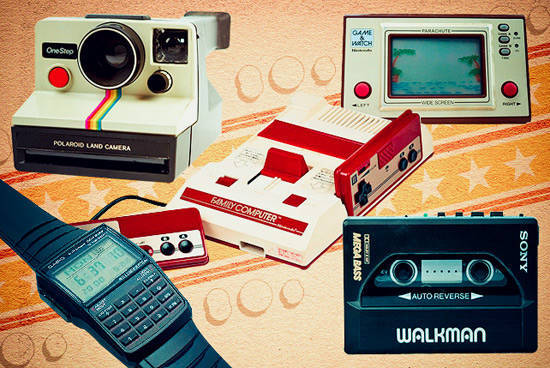
    Life today without gadgets is unthinkable, isn’t it? Be it smartphones, tablets, laptops or a wide plethora of other goods and gadgets, we cannot imagine a single moment bereft of them. Without these gadgets would be like going back to the Stone Age! So take a moment to imagine how life would have been in the ’80s and ’90s when all these were just a dream and kids and teenagers were more than happy and content using the gadgets of that time (and going out more to play). Here are some gadgets which were hit back at that time-

    • Cameras

    Remember the Kodak/Yashika camera running on reels? Before the advent of its digital counterparts, these cameras ruled our world, well our albums at least. With a limited photo quantity (Read: 36) these were our travelling companions and definitely the keeper of memories. Nowadays we have digital cameras, DSLRs and mobiles which can take umpteen photos. With a 47 mm lens and no pixel CCD sensor, photographers would have to look through the tiny glass hole present at the upward portion of the camera for adjustments as there was no screen on the camera.

    Source- https://m.media-amazon.com/images/I/61uK61nr7yL.SL1280.jpg
    •  Boom box/Tape Recorder

    Another one of our favourites, the boom box was our constant companion over to the gym/aerobics class and also the best way to kill time. What could be more pleasant than sitting back and listening to your favourite song at high volume? The same instrument also served as a recorder and we did record the voices of our near and dear ones, even of our own! These boom boxes or tape recorders had different kinds of cassettes; unlike the CDs and DVDs which we see flooding the market these days. They had magnetic tapes.

    Source- https://cdn.pixabay.com/photo/2020/08/06/09/27/boombox-5467421__480.png
    • Video Games

    Another great addictive addition to this list, we all loved playing video games as children. Be it Super Mario, Duck Shooting, Olympic Games or Contra we were addicted to these games throughout our childhood. Who knew these video games would be replaced with computers and laptops in the coming decade. My personal favourite was the shooting games like Duck Hunt and Clay Shooting using the fake plastic gun which possibly contained an infrared mechanism attached to the video game CPU. My favourite companies were Nintendo, Sony, Sega and a couple of Indian version brands.

    Source- https://d1e00ek4ebabms.cloudfront.net/production/5e42cf1d-3130-4c0e-96a2-ff1b39fdfb97.jpg
    • Pager

    Before mobile phones took the world by storm and made it even smaller, pagers were the closest to their mobile counterparts. They could deliver alphanumeric messages or even voice messages in costlier models. I still remember how people with pagers would fondly and proudly display their device which was (most of the time) attached to their belts. Pagers have a small green screen where the messages flash on. Pagers support direct connection protocols and are faster than cellular-based communication and cannot be traced. Some of the popular companies which manufactured them were Motorola, Sony, Beetel etc.

    Source- https://assets.rbl.ms/25587494/origin.jpg
    • Walkmans and Headphones

    This golden period also gave birth to headphones and walkman companies like Sennheiser, Bose, Sony Walkman and many others. The first step towards iPods these walkmans were our first personalized music companions and I remember starting to headbang with my first walkman!   

    Source- https://assets.rbl.ms/25587221/origin.jpg

    Thus in addition to the above-mentioned gadgets, there were other gadgets too that rocked and ruled our world in the ’80s and ’90s. Listing them all would be a tough job to do! These were the top ones according to me.

  • 15 things you grew up with that have mostly disappeared

    15 things you grew up with that have mostly disappeared

    Being born during the ’80s to ’90s was not an easy task for the likes of us. For we have seen stuff and things from our timeline disappear and new things take their place. In this article let us bring a little nostalgia to the plate and discuss 15 such things which we have seen growing up but are no longer available in the market; in other words, they are extinct! From pagers to the old Windows operating systems, to handheld video games to evergreen serials like Malgudi days, we wish something’s never changed. Here is the list enumerating 15 such things-

    Microsoft Windows 95

    Remember this primordial operating system from windows? One of the earliest operating systems, anybody having one of these was considered to be amongst the privileged lot. With the earliest versions of Paint and Microsoft Office, this OS (operating system) was top notch during those days.

    Handheld water games

    These handheld games involved looping small plastic rings onto one/two small rods only with the push of a button. Apparently as easy as this game may seem, actually it was very much addicting and hard. Pity such games are nowhere to be found now. It was really surprising that a game not involving any technology or digital medium could captivate the user so much.

    Mauser gun

    A plastic gun with round plastic bullets, this faux gun was many of our favourite pastimes. We felt like heroes wielding plastic guns and running helter-skelter. Truly the Mauser gun was an inseparable game companion for many of us growing up through the years. This gun even had a magazine full of yellow pellets

    Compact Disc (CD)

    Compact Disc or CD abbreviated was a mode of electronic storage of data that was popular in the ’90s and 2000s. But with the advent of the DVD, CD’s were rendered obsolete and useless. These days we tend to use memory sticks or pen drives more than DVD’s as well.

    Malgudi days

    Based on RK Narayan’s stories, this sitcom was perhaps everybody’s favourite. The adventures of Swami in a small south Indian village captured every viewer’s attention. With a little more than 50 episodes, this magnificent show disappeared into thin air without a trace. We surely want another scoop of this show anytime won’t we?

    White Rabbit (toffee) 

    Delicious and super tasty, these toffees were the ultimate delicacy for many of us. The trademarked white wrapper with the picture of a white rabbit in a blue outline was enough to make us drool and salivate. These tasty treats are banned now as they contain traces of melamine, a substance used in making plastics.

    Orkut

    Before the rise of Facebook, Google +, Hi5 and other social networks, Orkut was the uncrowned king of all social media applications. In fact, coolness in the teenage and youth societies meant having a mandatory Orkut account. However, during its short stint, it helped people connect, go on dates and even get married! It was less time consuming than Facebook as well.

    Brick Game (Hand-held video game)

    This video game was the perfect companion for killing time as it contained an umpteen number of games (as much as 9999 in 1!) albeit each game was a similar version of the previous one. Tetris, plane fights, snake were the common games to be found. The games were pre-loaded.

    Tazos

    These roundish plastic toys were given as free toys with any market commodity like cornflakes, chips, toothpaste and a variety of others. By intertwining two tazos, one could even make one fly at great speeds like a Frisbee. Children loved collecting them and even more when they had their favourite character or Pokémon etched on them.

    Video game parlors

    Most of us cannot deny that we did not spend a considerable time of our life in these parlours playing games like Contra, WWE Raw and other hugely popular action games. We would repeatedly nag our parents for letting us play in one of these parlours close to our home. It was pretty cool, wasn’t it? The machine only accepted coins.

    Video Cassettes

     There was an ancient time when shops had video cassettes and come every Sunday, we would really get excited about the prospect of watching a blockbuster movie in our VCR recorders. My first movie in a Video Cassette was The Mask by Jim Carrey. Nowadays they are fossilized, well almost!

    Rotary Telephones

    These telephones used back at the time when we were kids are nowhere to be nowadays. More than a telephone, they seemed like toys to us with their strange numeric keypad attracting the most attention. Dialers had to rotate a digit with their fingers and the entire process was very time-consuming.

    Parle Kiss-me

    This chocolate cost a hefty three rupee (three rupees was a lot back then) and was available primarily in elaichi flavour. With a red and white covered wrapper, Parle Kiss-me was ‘the’ chocolate in terms of taste and money. This was many kids’ favourite chocolate until dairy milk and 5-Star flooded the market with a plethora of flavours and options to choose from.

    Pop-Pop boats

    Available in markets and mainly fairs, this boat made us want one whenever our eyes used to fall on them. They operated on candle or vegetable oil and made a distinct sound that attracted us when we were kids. It had a spoon-like structure at end of which contained the oil.

    Roller ball mouse

     The mouse we use these days is an optical one but back then the only mouse available was the roller ball mouse which operated on a rollerball. Kids used to open up the mouse and play with the ball rather than using it to operate the mouse. Life those days was pure bliss.

  • A Brief History of ASR: Automatic Speech Recognition

    A Brief History of ASR: Automatic Speech Recognition

    This moment has been a long time coming. The technology behind speech recognition has been in development for over half a century, going through several periods of intense promise — and disappointment. So what changed to make ASR viable in commercial applications? And what exactly could these systems accomplish, long before any of us had heard of Siri?

    The story of speech recognition is as much about the application of different approaches as the development of raw technology, though the two are inextricably linked. Over a period of decades, researchers would conceive of myriad ways to dissect language: by sounds, by structure — and with statistics.


    Early Days

    Human interest in recognizing and synthesizing speech dates back hundreds of years (at least!) — but it wasn’t until the mid-20th century that our forebears built something recognizable as ASR.

    Paint_1

    1961 — IBM Shoebox

    Among the earliest projects was a “digit recognizer” called Audrey, created by researchers at Bell Laboratories in 1952. Audrey could recognize spoken numerical digits by looking for audio fingerprints called formants — the distilled essences of sounds.


    In the 1960s, IBM developed Shoebox — a system that could recognize digits and arithmetic commands like “plus” and “total”. Better yet, Shoebox could pass the math problem to an adding machine, which would calculate and print the answer.


    Meanwhile, researchers in Japan built hardware that could recognize the constituent parts of speech like vowels; other systems could evaluate the structure of speech to figure out where a word might end. And a team at University College in England could recognize 4 vowels and 9 consonants by analyzing phonemes, the discrete sounds of a language.


    But while the field was taking incremental steps forward, it wasn’t necessarily clear where the path was heading. And then: disaster.

    Paint_2

    October 1969 — The Journal of the Acoustical Society of America


    A Piercing Freeze

    The turning point came in the form of a letter written by John R. Pierce in 1969.

    Pierce had long since established himself as an engineer of international renown; among other achievements, he coined the word transistor (now ubiquitous in engineering) and helped launch Echo I, the first-ever communications satellite. By 1969 he was an executive at Bell Labs, which had invested extensively in the development of speech recognition.


    In an open letter³ published in The Journal of the Acoustical Society of America, Pierce laid out his concerns. Citing a “lush” funding environment in the aftermath of World War II and Sputnik, and the lack of accountability thereof, Pierce admonished the field for its lack of scientific rigor, asserting that there was too much wild experimentation going on:


    “We all believe that a science of speech is possible, despite the scarcity in the field of people who behave like scientists and of results that look like science.” — J.R. Pierce, 1969


    Pierce put his employer’s money where his mouth was: he defunded Bell’s ASR programs, which wouldn’t be reinstated until after he resigned in 1971.


    Progress Continues

    Thankfully there was more optimism elsewhere. In the early 1970s, the U.S. Department of Defense’s ARPA (the agency now known as DARPA) funded a five-year program called Speech Understanding Research. This led to the creation of several new ASR systems, the most successful of which was Carnegie Mellon University’s Harpy, which could recognize just over 1000 words by 1976.


    Meanwhile, efforts from IBM and AT&T’s Bell Laboratories pushed the technology toward possible commercial applications. IBM prioritized speech transcription in the context of office correspondence, and Bell was concerned with ‘command and control’ scenarios: the precursors to the voice dialing and automated phone trees we know today.


    Despite this progress, by the end of the 1970s, ASR was still a long ways from being viable for anything but highly-specific use-cases.

    Paint_3

    This hurts my head, too.

    The ‘80s: Markovs and More

    A key turning point came with the popularization of Hidden Markov Models(HMMs) in the mid-1980s. This approach represented a significant shift “from simple pattern recognition methods, based on templates and a spectral distance measure, to a statistical method for speech processing”—which translated to a leap forward in accuracy.


    A large part of the improvement in speech recognition systems since the late 1960s is due to the power of this statistical approach, coupled with the advances in computer technology necessary to implement HMMs.


    HMMs took the industry by storm — but they were no overnight success. Jim Baker first applied them to speech recognition in the early 1970s at CMU, and the models themselves had been described by Leonard E. Baum in the ‘60s. It wasn’t until 1980, when Jack Ferguson gave a set of illuminating lectures at the Institute for Defense Analyses, that the technique began to disseminate more widely.


    The success of HMMs validated the work of Frederick Jelinek at IBM’s Watson Research Center, who since the early 1970s had advocated for the use of statistical models to interpret speech, rather than trying to get computers to mimic the way humans digest language: through meaning, syntax, and grammar (a common approach at the time). As Jelinek later put it: “Airplanes don’t flap their wings.”


    These data-driven approaches also facilitated progress that had as much to do with industry collaboration and accountability as individual eureka moments. With the increasing popularity of statistical models, the ASR field began coalescing around a suite of tests that would provide a standardized benchmark to compare to. This was further encouraged by the release of shared datasets: large corpuses of data that researchers could use to train and test their models on.


    In other words: finally, there was an (imperfect) way to measure and compare success.

    Paint_4


    November 1990, Infoworld


    Consumer Availability — The ‘90s


    For better and worse, the 90s introduced consumers to automatic speech recognition in a form we’d recognize today. Dragon Dictate launched in 1990 for a staggering $9,000, touting a dictionary of 80,000 words and features like natural language processing (see the Infoworld article above).


    These tools were time-consuming (the article claims otherwise, but Dragon became known for prompting users to ‘train’ the dictation software to their own voice). And it required that users speak in a stilted manner: Dragon could initially recognize only 30–40 words a minute; people typically talk around four times faster than that.


    But it worked well enough for Dragon to grow into a business with hundreds of employees, and customers spanning healthcare, law, and more. By 1997 the company introduced Dragon NaturallySpeaking, which could capture words at a more fluid pace — and, at $150, a much lower price-tag.


    Even so, there may have been as many grumbles as squeals of delight: to the degree that there is consumer skepticism around ASR today, some of the credit should go to the over-enthusiastic marketing of these early products. But without the efforts of industry pioneers James and Janet Baker (who founded Dragon Systems in 1982), the productization of ASR may have taken much longer.

    Paint_5


    November 1993, IEEE Communications Magazine


    Whither Speech Recognition— The Sequel


    25 years after J.R. Pierce’s paper was published, the IEEE published a follow-up titled Whither Speech Recognition: the Next 25 Years⁵, authored by two senior employees of Bell Laboratories (the same institution where Pierce worked).


    The latter article surveys the state of the industry circa 1993 when the paper was published — and serves as a sort of rebuttal to the pessimism of the original. Among its takeaways:


    • The key issue with Pierce’s letter was his assumption that in order for speech recognition to become useful, computers would need to comprehend what words mean. Given the technology of the time, this was completely infeasible.
    • In a sense, Pierce was right: by 1993 computers had a meager understanding of language—and in 2018, they’re still notoriously bad at discerning meaning.
    • Pierce’s mistake lay in his failure to anticipate the myriad ways speech recognition can be useful, even when the computer doesn’t know what the words actually mean.


    The Whither sequel ends with a prognosis, forecasting where ASR would head in the years after 1993. The section is couched in cheeky hedges (“We confidently predict that at least one of these eight predictions will turn out to have been incorrect”) — but it’s intriguing all the same. Among their eight predictions:


    • “By the year 2000, more people will get remote information via voice dialogues than by typing commands on computer keyboards to access remote databases.”
    • “People will learn to modify their speech habits to use speech recognition devices, just as they have changed their speaking behavior to leave messages on answering machines. Even though they will learn how to use this technology, people will always complain about speech recognizers.”


    The Dark Horse


    In a forthcoming installment in this series, we’ll be exploring more recent developments and the current state of automatic speech recognition. Spoiler alert: neural networks have played a starring role.


    But neural networks are actually as old as most of the approaches described here — they were introduced in the 1950s! It wasn’t until the computational power of the modern era (along with much larger data sets) that they changed the landscape.


    But we’re getting ahead of ourselves. Stay tuned for our next post on Automatic Speech Recognition by following Descript on Medium, Twitter, or Facebook.

    Paint_6

    Timeline via Juang & Rabiner


    This article is originally published at Descript.