Category: Culture & Society

  • Can India be free of single-use plastics by 2022?

    Can India be free of single-use plastics by 2022?

    Plastic is both a miracle and a curse for the modern world; miracle owing to its far-reaching usage and its strength and adaptability and curse because of the fact that those long polymer chains that make plastic so indispensable also render it nondegradable. Truly the world is full of ironies; take the case of single-use plastics, for example, we use single-use plastics for maybe a few hours at most but they remain on the earth’s surface for hundreds of years before disappearing from the face of the planet.

    Source

    What are single-use plastics?

    Single-use plastics are those kinds of plastics that are disposable in nature and as the name suggests are used only once before throwing it away for recycling or for filling up landfills and oceans. Straws, plastic cups, almost all food packaging, disposable water bottles, plastic sachets, coffee stirrers are some of the common items that fall under the category of single-use plastics.

    What are the various plastic types that can be recycled?

    Source

    Broadly, there are seven plastic types that can be recycled and used back in the plastic chain.

    Source

    Can single-use plastics be recycled?

    Recycling single-use plastics is an extremely labour-intensive process and, in many cases, they cannot be recycled owing to some fundamental, feasibility and technical difficulties. That means even if we ramp us the recycling industry and improve the supply chain management so that recycled plastic pellets effectively enter the chain of raw materials to plastic production factories, it is just not economically feasible.

    The problem at hand

    Now coming to the question at hand, it is difficult for India to get rid of single-use plastics by 2022. During the year-long period of 2016-2017, India generated about 1.6 million tonnes of plastic waste and during the same time, India consumed around 16.5 million tonnes of plastic. Now the mind-boggling fact is that out of this consumption, a staggering 43 percentage constitutes single-use plastics.

    Source
    Source

    Although India’s per capita usage is nearly not as much, if one combines this per capita usage with the population the country has, things begin to pile up really bad.

    Will banning single-use plastics help?

    Plastic is linked to every major industry not only in India but the entire world and curbing single-use plastics can impact the growth rate of these industries by a massive margin. The plastic industry in India is sprawling with an estimated annual revenue worth of Rs. 3.5 lakh crore in the financial year of 2019. There are an estimated 50,000 units associated with the sector with the majority of them belonging from the small to medium enterprise range.  Besides, India earns a significant amount of revenue by importing plastics and raw materials related to plastics.

    Source

    Supply Chain Management problem

    Recycling single-use plastic requires a solid infrastructure, and coupled with a robust supply chain management would help the environment get rid of unnecessary plastic waste. As seen from the picture above, the percentage of recycling in India is quite high but it is largely driven by the poor.

    In fact, most of the rag pickers are young who have sacrificed their childhood and education and taken up rag picking. Government intervention is the need of the hour and through funds, more and more eco-friendly start-ups need to be encouraged to tackle the problem head-on.

    Source

    What can be done

    Recycling should be the government’s first goal as it provides the best sustainable option for industries and people to continue using single-use plastic without its disastrous consequences.

    Seeing the challenges that India face, operation and supply chain wise, India can adopt some of the measures that are already in full swing in other countries-

    • Projects similar to the Ocean Cleanup Project

    The Ocean Cleanup Project was started by a very young Dutch inventor, Boyan Slat in the year 2014 and it leverages technology to clean up waste from the oceans. Recently the company launched their autonomous interceptors that work with the help of solar energy to collect trash from rivers even before they enter into the world’s oceans.

    Website- https://theoceancleanup.com/

    Source
    • Anaerobic Decomposition of Plastic to yield fuel

    Plastic can be converted back into its initial form (oils) through the process of anaerobic decomposition, i.e. heating of plastic in a vacuum environment, which is termed as plastic pyrolysis. Through the process, plastic transforms depolymerization to gasification and finally condensation. The final product releases less carbon monoxide and pollutants into the atmosphere when mixed with conventional fuel to run automobiles. Recently, Satish Kumar from Hyderabad has been operating a plant that pyrolyzes plastic into fuel.

    Source [Satish Kumar & the final product]
    Source
    • Burning plastic to give energy

    One of the more unconventional methods to dispose off plastic waste is to burn it to release energy and then use that energy to generate electricity to either power or warm houses during the harsh winters. Trash consisting of mostly plastic wastes replace the traditional coal or gas in thermal power stations. Sweden has been using this method for many years now and now it imports trash from other countries for this very purpose. The energy generated is used to power the plants as well and to power the various filters that make sure that no harmful gases get released into the atmosphere during the entire process.

    Source

    Conclusion

    According to me, it is extremely difficult to be free of single-use plastics by 2022 because of the intricacies involved and the deep and far-reaching implications of the plastic industry on other major industries. More important than the question of “Can: India be single plastic free, is the question of “Should” India be single plastic-free. Sustainability is the need of the hour and through recycling and other methods discussed here, stability can be maintained so that a strong feedback loop forms that directly feeds into the primary supply chain.

    Resources-

    https://www.acplasticsinc.com/informationcenter/r/7-different-types-of-plastic-and-how-they-are-used

    https://www.businesstoday.in/current/economy-politics/ban-on-single-use-plastic-what-products-industries-will-be-hit/story/379134.html

    https://www.teriin.org/sites/default/files/files/factsheet.pdfhttps://energynews.us/2013/10/17/midwest/is-burning-garbage-green-in-sweden-theres-little-debate/
  • Developing Infrastructure for Differently abled

    Developing Infrastructure for Differently abled

    Introduction

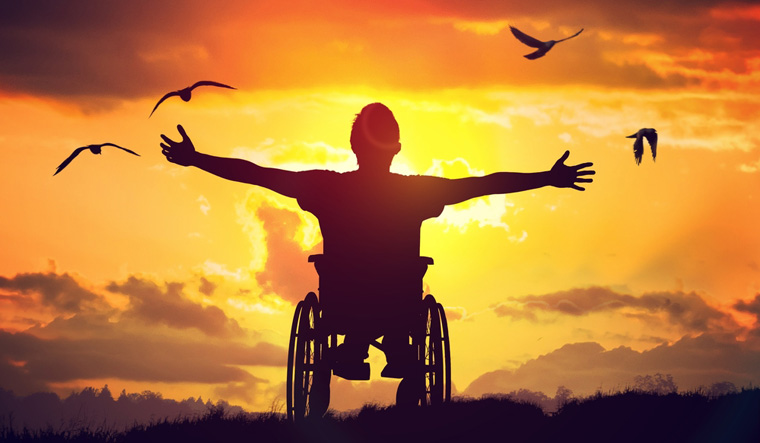
    The lexicon defines a “differently-abled individual” as someone who has a physical or mental disability that limits the individual from performing normal day to day functions. But the cold-hearted definition does not take into account emotions, it only defines the term as it is. It is therefore much prudent to refer such individuals not as disabled, but differently-abled, as there are examples aplenty wherein differently-abled people have achieved so much more than people without disabilities.

    Statistics

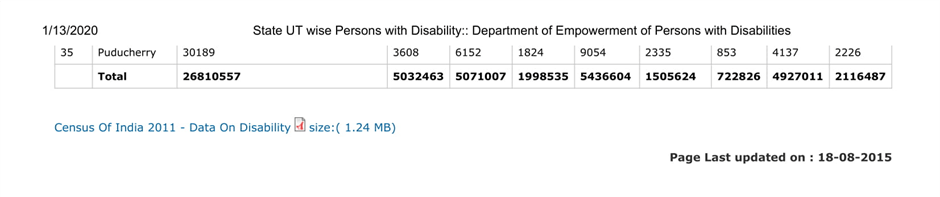
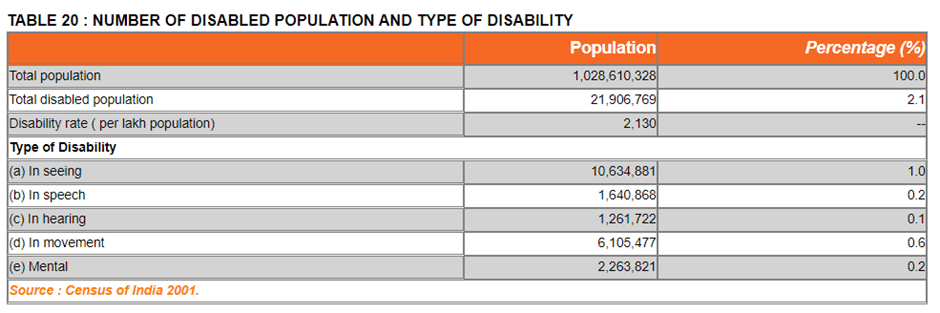
    In India, according to the 2001 census, over 21 million people (2.1% of the population) are classified as differently-abled. Disability is sight is leading the list (owing to a severe shortage of corneas for replacement) followed by others.

    Source

    Statewise, Uttar Pradesh leads the tally in the total disabled population and Lakshadweep has the lowest amongst all the states and the Union Territories.

    Source
    Source
    Source

    Infrastructure

    Infrastructure can be both tangible and intangible and in the case of differently-abled, both hold equal and paramount importance. A country should not see its differently-abled population as a liability but as an opportunity.

    Corporates

    Law in developed countries such as Germany requires that at least 5% of their organizations must be filled by the differently-abled which if flouted will lead to heavy penalties by the government. Sensitivity training is another important issue that needs to be addressed by corporations in India; given how people are prone to treating the differently-abled as second class citizens.

    Education

    Education is of primary importance to a developing country such as India, and more so for its differently-abled personnel and for this, the universities, schools, and colleges must take up combined onus. Firstly, differently-abled students must be facilitated into various courses and basic guidance regarding career choices must be provided to all such students. Awareness and sensitization of teachers and fellow students and scholars is of utmost need, and of the ways of doing this is to observe important days like World Disability Day.

    Basic infrastructures

    Basic infrastructure must not be forgotten, and the following are some of the ways basic infrastructure can be enabled across a plethora of important landmarks-

    • All Banks, ATM’s and other places of importance should have a ramp for differently-abled individuals
    • Offices and even public restrooms must have a differently-abled section (there is a handbook of guidelines under the Swachh Bharat Mission)
    • Specialized entry and exit for differently-abled across the public transportation system
    • Footpaths (both outside and within public buildings/offices) that are friendly to walk for the differently-abled
    • Applications (mobile and PC based) that help in navigation and day to day functionality to be made more accessible to the differently-abled so that they gain value from the same.
    • Differently-abled people should have special legal support to ensure they don’t face discrimination.

    Conclusion

    To conclude, it is sufficient to say that gradual and steady steps in this direction, as mentioned above, will not only help the differently-abled, but will help the country and its economy as a whole.

    References-

  • Restraining Anxiety and Importance of Mental Health during Isolation

    Restraining Anxiety and Importance of Mental Health during Isolation

    “What mental health needs is more sunlight, more candor, and more unashamed conversation.”

    Glenn Close

    Setting the premise

    Setting the premise

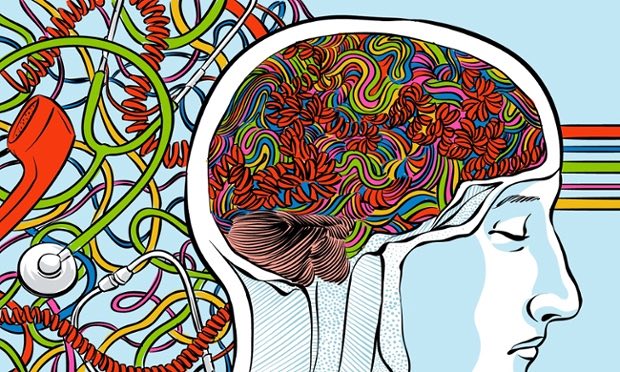
    As the situation around us worsens progressively every day, something that needs to be talked about but isn’t given enough importance is mental health. The psychological impacts of quarantine on the brain can be significant.

    The disorientating fact about mental health during a global pandemic is the fact that there are multiple dimensions to it. As more and more existing employees are furloughed and terminated and new employee offers rescinded, this induces extreme pressure and stress on the minds of those affected.

    Source

    The state of lockdown triggers emotions of claustrophobia and induces a sense of desperation that arises from a need to move out of closed quarters. All this combined with the fear of contracting the virus itself bogs down on the mind deep enough to start causing problems.

    Millennials and Mental Health

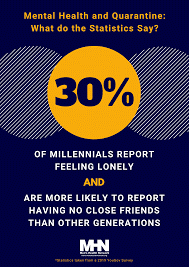
    Millennials are one of the worst affected by the virus and studies show that millennial women are more prone to stress and anxiety. Some of the key contributors to this are financial independence, worries about parents and loneliness. It is ironic that in today’s technically advanced world with so many social networking websites available at the touch of a button, millennials are more friendless than ever.

    Source

    Coping with the situation at hand

    For the last three years, I have been diagnosed with misophonia, a sound sensitivity disorder that had taken root within me causing anxiety and mild depression. Here are a few things that I at Digital Dribble, have personally been able to benefit from-

    • Guided Meditation- One of the best ways of combating anxiety, stress, and other mental issues is guided meditation. I have been personally using Headspace, a guided meditation application, and it has helped me tremendously to overcome my issues related to anxiety and misophonia.
    • Brahmi and Ashwagandha tablets/powder- Both of these help in relaxing the nerves of our body, thereby providing a soothing effect in addition to improving concentration, maintaining proper sleep, and also improving memory. A detailed account can be found in one of my Quora answers, here.
    • A healthy diet- As cliche as it may sound, a healthy diet can work wonders for the mind. In addition to eating, cooking healthy meals can also be relaxing as studies show that cooking your food has mental health benefits!
    • Daily freehand exercise- The effects of exercising daily cannot be underestimated. Exercise, even in closed-off surroundings, helps keep the brain fresh and active.

    Furthermore, maintaining a daily routine by breaking up tasks into subparts can help a lot. It is crucial to focus on the positive aspects of life right now and to limit the amount and kind of media you consume to prevent an anxiety attack or stress. If you do find yourself struggling, you can combat loneliness by staying connected to your loved ones.

    Stuck at home with a partner? Read how an exercise partner can improve your results!

    Source

    References